The evaluation
People returning to their communities after incarceration deserve tools that meet them where they are. To find out whether Atlas delivers on that promise, an independent evaluator — Steven L. Proctor, Ph.D., founder of PRO Health Group — studied Atlas inside Dismas Charities, one of the country's largest residential reentry providers. The evaluator had no role in Atlas's design or development.
The mixed-methods evaluation ran from November 2025 to January 2026 across two program sites — Manchester, Kentucky, a rural setting, and Atlanta, Georgia, an urban one — to ensure perspectives from both rural and urban reentry populations.
The design combined eight validated and purpose-built quantitative measures with 60-minute, in-depth qualitative interviews. Twenty participants — ten clients and ten staff members — completed both interviews and online surveys. The qualitative dataset spanned 589 pages of transcripts, analyzed using NVivo qualitative analysis software.
"Your mind is like a garden. If you plant seeds in it, they will grow. … Atlas is actually planting things in your mind. How are we to change the way we think if we don't plant anything in the mind?"
— Client, Atlanta
Atlas usability ratings
Usability was assessed using the System Usability Scale (SUS), a widely cited industry benchmark in which any score above 68 is considered above average. Atlas scored well above that line with both clients and staff.
70% of clients and 80% of staff scored Atlas above the above-average usability cutoff. Both groups described the platform as easy to learn, easy to navigate, and well integrated into daily routines — most clients access Atlas on their personal smartphones.
"Atlas is an easy tool to use without needing anything else."
"It's pretty user friendly - lots of sliders and check boxes. I like that I can access it anytime. I like that it's interactive."
What staff are saying
Staff describe Atlas as a tool that strengthens their practice rather than adding to it. Four themes dominated the staff interviews.
1. AI summaries are saving staff hours every week
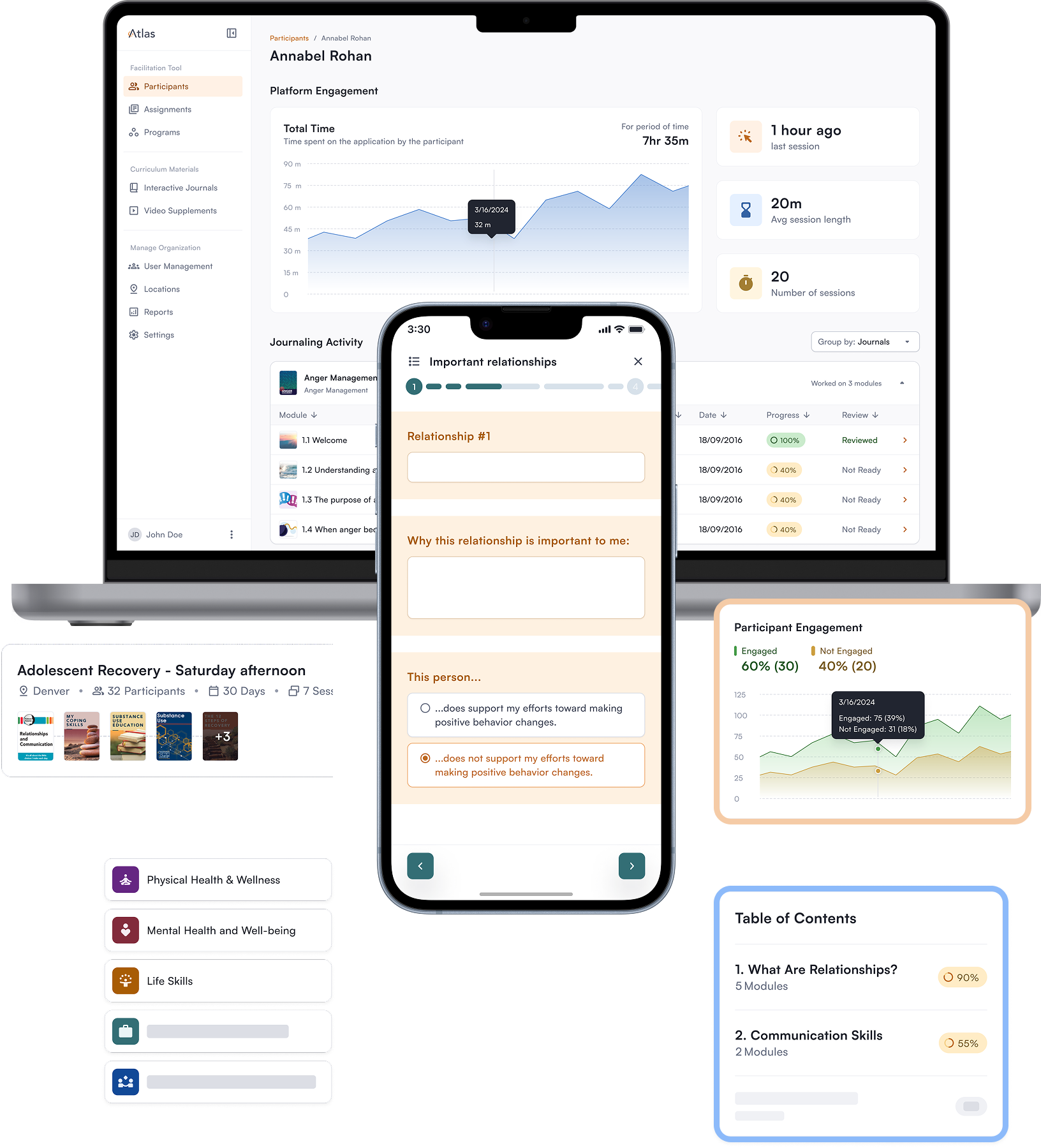
The AI journaling-response summary feature was the most consistently used and most highly praised feature in the platform. Staff estimated time savings ranging from six to 10 hours per week, depending on caseload.
"One of my guys did like 12 different Journals. I had like 400 and something pages to review. That saved me probably 6 hours of my life."
2. Atlas opens doors clients don't open in person
Staff repeatedly noted that journaling reaches clients in ways group sessions cannot.
"Some of them don't open up in group. But they'll write things in the journals they wouldn't say out loud."
3. Completion certificates are a quietly powerful motivator
Staff described Atlas's completion certificates as one of the most universally praised features for clients — tangible recognition for individuals who often have few formal achievements to celebrate.
"They always smile when I give it to them… This actually feels like a reward in a way. Makes you feel good."
4. Staff believe in the impact of Atlas on important reentry outcomes
100% of staff surveyed stated that Atlas provides useful tools for helping clients overcome challenges in reentry, manage personal relationships or interactions, and increase motivation to make positive changes.
What clients are experiencing
Clients themselves describe Atlas as a tool that helps them think, slow down, and rebuild. Three themes emerged again and again.
1. Reflection and self-awareness
Clients used Atlas to process emotions, recognize patterns in their behavior, and develop healthier coping strategies. 80% of respondents said Atlas helped improve general mental health and manage anger, and 80% said Atlas helped them manage personal relationships or interactions with others.
"It actually helps me on a psychological level deal with people. … It actually helps me have certain conversations like with my daughter."
2. Identity and hope
Clients consistently described journaling as a way to reclaim a sense of self after incarceration. 90% said Atlas helped them feel more confident in their ability to make positive life changes.
"It helped me start to realize that I'm not a number. I'm [name] and I do have value … to move forward in my life."
3. Real-world skills they can apply immediately
Parenting, communication, budgeting, and employment journals were called out as immediately applicable to daily life, with 80% of clients saying Atlas is helping them stay on track with supervision requirements and feel more prepared to move forward after incarceration.
"It gave me about five or six 'aha' moments — how to market yourself and how to make yourself not look at what your past failures were, but what your future holds."
Digital journaling is strongly preferred
Seventy percent of staff selected digital as their overall preference, and 80% said clients want to journal more often in the digital format. Among clients, 50% preferred digital and another 30% said digital and written formats work equally well — leaving only 20% who prefer pen-and-paper.
Eight out of eight domains assessed — clarity, honesty, ease of use, motivation, goal adherence, sense of control, problem understanding, and overall preference — showed a majority preferring digital, or rating the two formats as equally effective.
Written
"When you see that progress on the screen — 20%, 40% — it helps. Seeing that motivates me. You don't get that with a notebook."
"Digital journaling is more private — them and me are the only ones seeing it, versus if they left their journal out or someone got a hold of it."
Four outcomes central to successful reentry
Motivation and self-efficacy
95% of clients said Atlas increased motivation to make positive changes, while 90% said it increased confidence in their ability to change.
Reduced recidivism risk
80% of clients and staff said Atlas helps clients avoid behaviors that could lead them back to prison.
Mental health and relationships
85% said Atlas supports personal relationships, while 80% said it supports mental health and anger management.
Reentry readiness
85% said Atlas provides useful tools for overcoming reentry challenges; more than 75% reported gains across multiple readiness indicators.
"Because if you do it, it's gonna work. Works if you work it."
— Client, Manchester