The Heartland House approach: Full-program integration
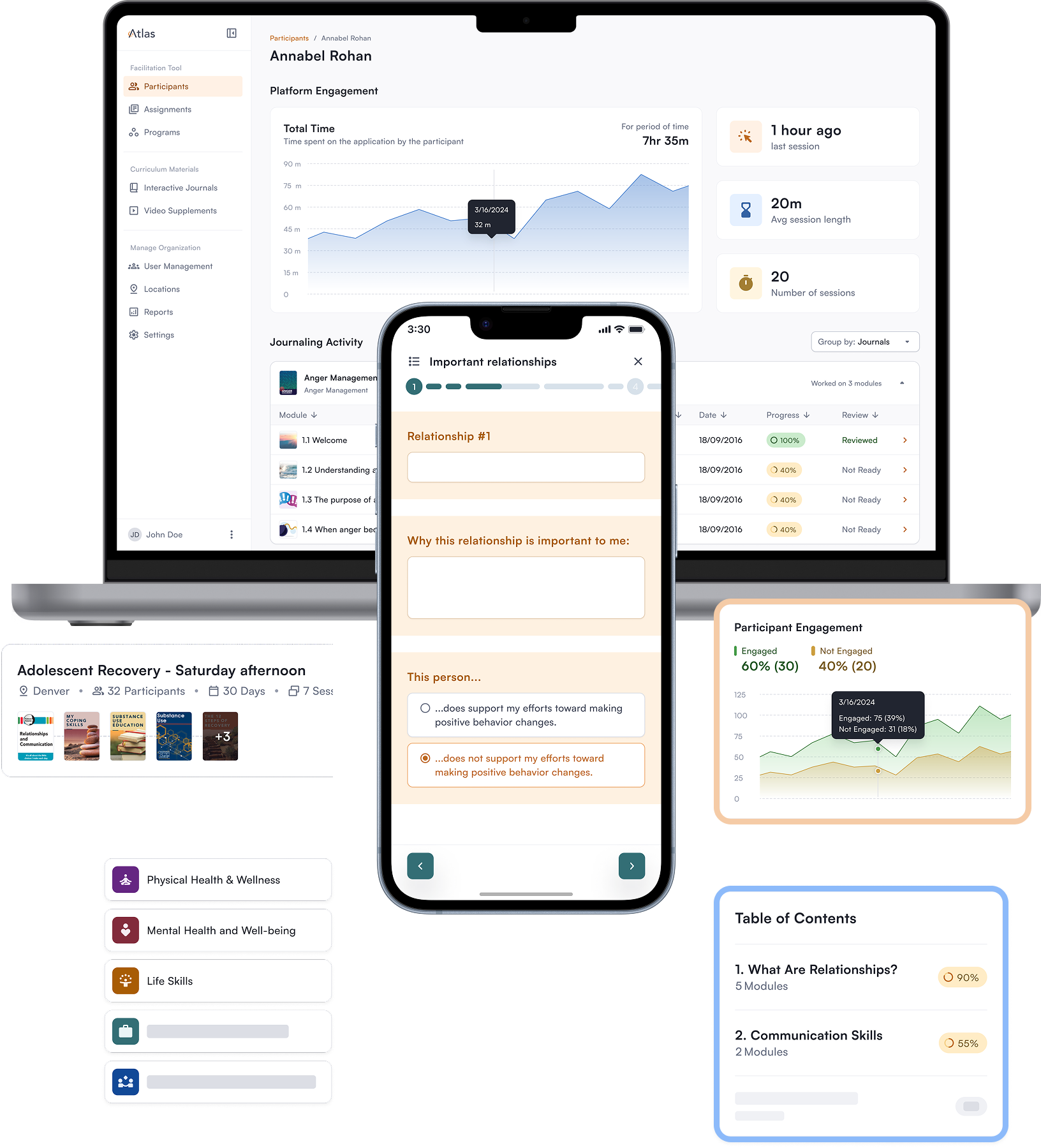
Heartland House embedded Atlas directly into its residential programming rather than treating it as a supplemental tool. According to Robert, "It's the complete program. Everybody engages in our programs. We're using Atlas in its entirety all the way through the process so it can be replicated."
Participants complete structured assignments in Atlas between groups, and counselors incorporate insights into one-to-one sessions. Treatment plans are treated as, in Robert's words, "living and breathing documents," so new Atlas assignments are made as goals and needs evolve.
Individualized assignment strategy
When patterns emerge in client work, staff assign targeted Journals or deepen clinical conversations. As one staff member shared, "Many of the curriculum in Atlas are focused on recovery goals, so it does align with exploration of their own treatment plans."
Real-time clinical insight
One of the most significant workflow improvements has been continuous visibility into client progress.
Robert explained, "We can go in and actually see what they're writing in real time or what their progress has been since the last time we've interacted with them. And that gives us a huge advantage."
Another staff member noted, "Information from Atlas provides a clear direction for interventions to improve client relations. There are no secrets."
Finally, as one staff member indicated, Atlas may provide a safer space to express difficult thoughts and feelings prior to expressing them to a counselor. "There could be information there that was hard for the client to be forthcoming with in person," they noted.
Reinvesting efficiency gains
Heartland House reports that early efficiencies have already enabled program expansion.
"The data showed an 18% improvement. But what it didn't show was that it freed up enough time to where we have initiated a mindfulness-orientated recovery enhancement group now which is four hours a week."
— Robert Cook, Executive Director
Outcomes and early results
At the six-month mark, Heartland House is seeing encouraging early indicators across staff feedback, client experience, and operational impact. Leadership emphasizes that longer-term outcomes are still being tracked.
Staff Survey Results (February 2026)
In a survey administered to 10 staff in February 2026, perceptions of Atlas were strongly positive:
- Overall positive impact: 4.5 / 5
- Used Atlas insights to guide care and address challenges earlier: 4.1 / 5
- Used Atlas insights to improve therapeutic relationship: 4.5 / 5
- Strengthened client engagement: 4.4 / 5
- Supported treatment plan achievement: 4.3 / 5
- Helped clients apply skills: 4.2 / 5
Qualitative feedback from staff included:
"[Atlas promotes] time efficiency and comprehensive person-centered engagement."
"Atlas gives clients the opportunity to look inside themselves by providing questions that require thought."
"The clients have mentioned that they like the Atlas journaling. It has made them more involved with their recovery."
"I can now spend time with the clients in areas I may have missed or did not have time before."
Client Survey Results (February 2026)
In a survey administered to 10 clients in February 2026, client feedback reflected meaningful engagement and self-reflection:
- Confidence in goal achievement as a result of using Atlas (1-10): 8.3
- Confidence in applying journaling concepts to everyday life (1-10): 8.5
- Ease of navigating Atlas (1-5): 4.1/5
- Ease of accessing Journals on device (1-5): 4.3/5
- Visual layout helped with engagement (1-5): 4/5
Qualitative feedback from clients included:
"I'm finding out a lot about myself; how to think and a different way about life."
"I've been finding helpful things in Atlas. The Anger Management, Positive Self-talk and Recreation and Leisure have helped a lot."
"I like how it motivates you and instead of pointing out your flaws, it shows the good in you."
When asked what they liked most about Atlas, client responses included:
"The freedom to write the statements and the enjoyment I got from reflecting back to the good ol' days"
"The fact that you can let out personal thoughts to a Journal"
"It's convenient for talk to text. It makes me feel good and accomplished."
"It's very easy to navigate and there is no paper, keeps it organized"
Operational and Clinical Impact
Beyond survey data, Heartland House reports several emerging benefits:
- More meaningful clinician time: Insights from Atlas help staff hold meaningful discussions with clients, focused on areas of greatest need. Tools that support documentation are also saving hours of time so staff can put the majority of their focus on time with clients.
- Earlier identification of needs: Atlas is helping surface issues sooner. "Things that were pretty well hidden, are starting to appear… and maybe sooner," said Robert.
- Stronger continuity of care: Because client work is visible across the team, transitions and treatment adjustments are more informed and timely.
Looking ahead
Heartland House leadership views the six-month mark as an early but promising signal. The organization plans to continue monitoring longer-term outcomes, particularly related to sustained recovery and successful step-down to lower levels of care.
Robert emphasized the program's core motivation: "If we can get one person… to gain insights that will assist them in not having a reoccurrence… that's where we're at."
When asked how likely he would be to recommend Atlas to peers, his response was definitive: "I've already done it… obviously a 10."
As longer-term data matures, Heartland House is well positioned to further demonstrate how technology-enabled care can support both workforce sustainability and client success in community treatment settings.