Meeting people where they are
For years, the Ventura County Sheriff's Office has invested in evidence-based programming designed to help incarcerated individuals build the skills they need for successful reentry. Under the leadership of Program Administrator Abigail Honorico, the agency has long relied on cognitive behavioral interventions to address the underlying thinking patterns and life skills that contribute to criminal behavior.
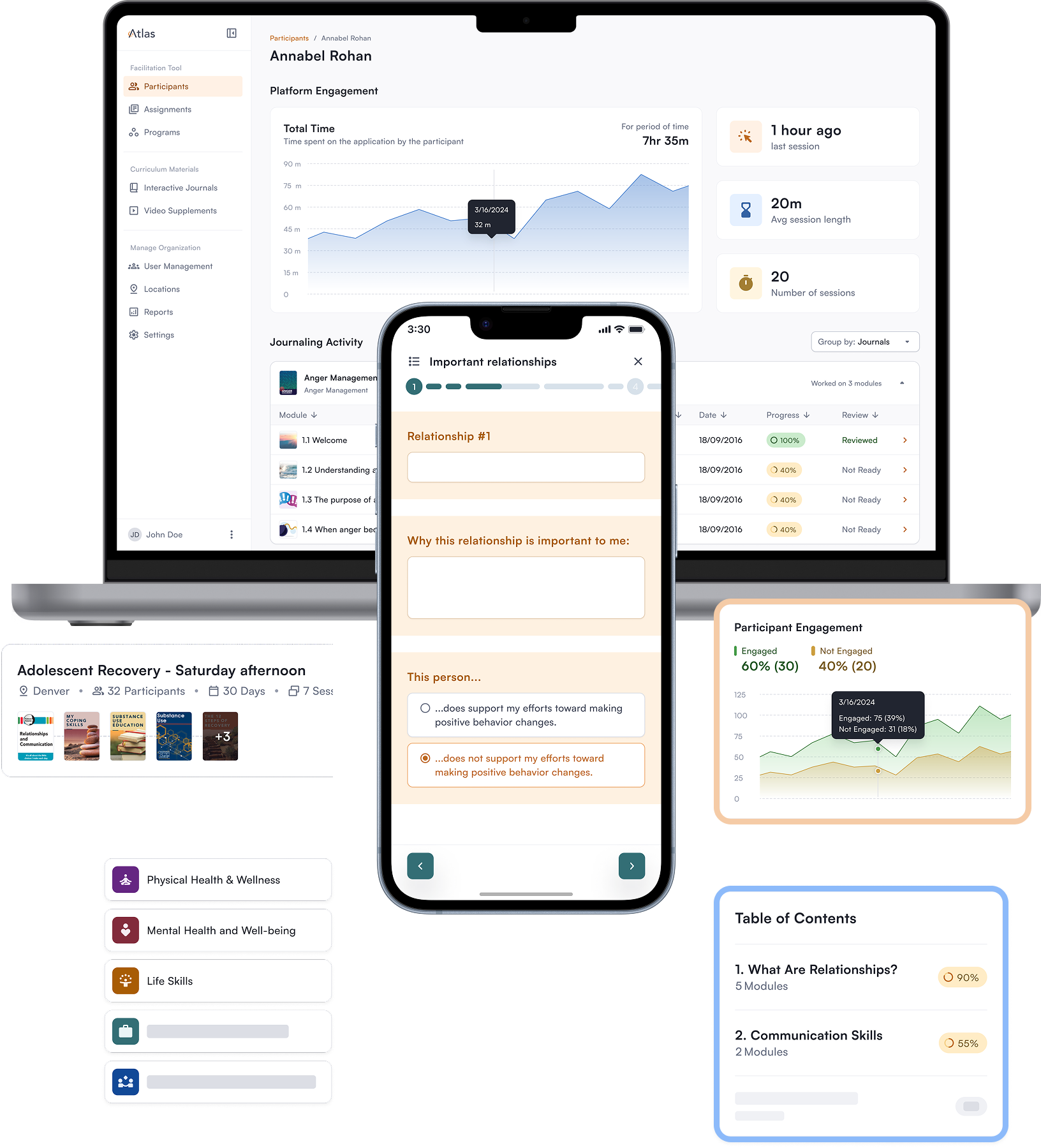
When digital delivery became available through Atlas, Ventura County expanded its ability to reach people who previously had few opportunities to participate.
"I am more than thrilled with Atlas... I think the inmates really love it. I love having the opportunity to educate inmates that I wouldn't be able to because of their classification."
— Abigail Honorico, Program Administrator, Ventura County Sheriff's Office
Today, Atlas is primarily used with individuals in Protective Custody (PC) housing — participants who often have limited access to traditional classroom programming because of security classifications, staffing realities, and operational constraints. For many of these individuals, Atlas provides one of the few opportunities to engage in structured cognitive behavioral programming during their incarceration.
Over the past year alone, participants have spent more than 866 hours engaging with Atlas across 7,830 learning sessions, completing evidence-based Interactive Journaling®, videos, and podcasts focused on thinking skills, emotional regulation, victim awareness, substance use recovery, and successful reentry.
Reaching people traditional programming couldn't
Like many correctional agencies across the country, Ventura County has experienced significant operational changes since COVID-19.
Lower staffing levels, fewer available classrooms, housing classifications, lockdowns, and competing work assignments have all made it more difficult to deliver consistent in-person programming. At the same time, many incarcerated individuals who most need behavioral programming are unable to attend traditional classes because of where they're housed.
Rather than viewing technology as a replacement for classroom instruction, Abigail saw Atlas as a way to ensure that programming could continue despite those realities. Atlas allows participants to complete evidence-based journal work independently while staff continue to facilitate discussions, coaching, and individual support whenever possible.
The approach has become especially valuable for Protective Custody populations.
"They make the best students. They're the hungriest because of their classification. There's not a whole lot that we can give them."
— Abigail Honorico, Program Administrator, Ventura County Sheriff's Office
Building a flexible model that works inside a jail
Ventura County has designed its delivery approach for Atlas around the realities of jail operations. Participants are enrolled in structured six-week learning cycles that align with the county's adult education partnership while accommodating required educational testing. Cohorts remain relatively stable from one course to the next, allowing staff to build continuity while minimizing administrative burden.
1. Learning continues when jail operations change
Importantly, Atlas provides flexibility when jail operations inevitably change. Lockdowns, work assignments, court appearances, and staffing shortages no longer bring learning to a halt. Participants continue progressing independently on their tablets until staff can reconnect with them.
2. Staff prioritize their limited time
The platform also helps staff prioritize their limited time. Rather than attempting to check in with every participant equally, instructors use Atlas dashboards and Journal activity to identify who may need immediate attention while allowing others to continue progressing independently.
"So that's what I love about it. Atlas is actually helping to triage who gets a check-in at any given time."
3. Less movement throughout the facility
Reducing unnecessary movement throughout the facility creates operational benefits as well.
"If you have one less person going in, it's fantastic. The deputies aren't stressed out... If it can all be done through the tablet... that's our goal."
Outcomes: Supporting lasting behavior change
Abigail has already seen firsthand how Atlas can help participants develop new insights about themselves — often in ways they didn't expect.
She recalls one participant who initially completed an anger management course, where he began recognizing how his reactions were affecting his relationships and family dynamics. When staff encouraged him to continue with a substance use course, he was hesitant.
Anger management course
He began recognizing how his reactions were affecting his relationships and family dynamics.
Encouraged to take a substance use course
When staff encouraged him to continue, he was hesitant.
New self-insight
Through every journal he encountered, he learned more and more about himself.
"He really didn't want to take it. He didn't think that he had a substance abuse issue."
But as he continued working through the Interactive Journaling® activities, something changed.
"I think through every journal that he encountered, he learned more and more of himself. And then that's when he's like, 'Wait a minute. I think I might have a substance abuse problem. I think I might not be handling my anger that very well.'"
— Abigail Honorico, Program Administrator, Ventura County Sheriff's Office
For Abigail, this individual's experience illustrates what evidence-based cognitive behavioral programming is designed to accomplish. Rather than telling participants what they need to change, the journaling process helps them arrive at those conclusions themselves — building the kind of personal insight that can motivate meaningful behavior change.
What participants engaged with most
Over the past year, participants have engaged in more than 7,800 learning sessions, with the most frequently accessed Interactive Journaling® topics including rational thinking, life management, victim awareness, and anger management. Participants also spent more than 100 hours listening to podcasts covering topics such as managing difficult feelings, challenging risky thinking, stress management, medication for opioid use disorder, and mindfulness, alongside videos focused on addiction, life skills, and rational thinking.
Interactive Journaling®
Most frequently accessed topics
- Rational thinking
- Life management
- Victim awareness
- Anger management
Podcasts
100+ hours of listening
- Managing difficult feelings
- Challenging risky thinking
- Stress management
- Medication for opioid use disorder
- Mindfulness
Videos
Topics covered
- Addiction
- Life skills
- Rational thinking
Future directions
Looking ahead, Abigail sees even greater opportunities.
She hopes to expand Atlas beyond Protective Custody populations, develop approved parenting and basic health curricula, and ultimately create a more connected "inside-out" reentry model — one that begins during incarceration and continues seamlessly into probation and community supervision.
Expand beyond Protective Custody
Bring Atlas to populations beyond Protective Custody housing.
New curricula
Develop approved parenting and basic health curricula.
An "inside-out" reentry model
A model that begins during incarceration and continues into probation and community supervision.
"Atlas is a great vehicle for that. If they start in jail... that's great that we can continue that same curriculum with probation."
For now, she's confident in recommending the platform to others.
"I'm really, really happy with Atlas. I've never not been happy."
— Abigail Honorico, Program Administrator, Ventura County Sheriff's Office