
Introduction
Historically, the juvenile justice system has aimed to increase public safety and hold young offenders accountable for their crimes (Office of Juvenile Justice and Delinquency Prevention, 2021). Ideally, juvenile justice seeks to promote successful reintegration into society through a balance of punitive action and restorative practice.
With these ideals in mind, the core question is how to implement effective programs that are practical, evidence-based, cost-effective and scalable within real-world constraints.
The core problem
Juvenile justice system leaders are under growing pressure to deliver effective interventions and care to justice-involved youth while facing a convergence of operational challenges, including staffing shortages and limited access to mental health and behavioral intervention resources.
Common system pressures
- Staffing shortages and high turnover
- Budget constraints
- Limited access to mental health care and behavioral intervention
- Unsustainable caseloads and documentation requirements
Probation departments, courts, and community partners feel a greater sense of responsibility to provide meaningful interventions that support behavior change, instead of simply monitoring compliance.
Key leadership questions
- What resources can help close gaps created by staffing and budget shortages?
- What supports are needed to engage youth in ways that promote pro-social behavior and long-term success?
- How can programs be designed so that they are both evidence-informed and scalable?
What does "evidence-based" mean in juvenile justice?
Evidence-based interventions such as cognitive behavioral therapy (CBT) and motivational interviewing (MI) are widely supported in juvenile justice research. However, effective evidence-based intervention means more than simply selecting a validated model, it also requires consistent implementation.
Program outcomes depend heavily on fidelity and delivery context. Programs that are difficult to staff, monitor or track often experience "drift," reducing effectiveness even when the underlying model is sound.
For system leaders, this distinction is critical. Selecting an evidence-based intervention is only the first step. Ensuring that it can be delivered consistently, monitored efficiently and sustained over time is equally important.
The role of behavioral and therapeutic interventions
Effective juvenile justice programs rely on structured behavioral and therapeutic interventions that address underlying drivers of system involvement.
When delivered consistently, these tools support both supervision goals and developmental outcomes. Structured materials reduce reliance on individual discretion and help ensure that all youth receive exposure to core skills, regardless of staff turnover or setting.
Core intervention functions
- Accountability and understanding consequences
- Skill development (decision-making, emotional regulation, problem-solving)
- Youth voice and guided self-reflection
Common concerns in juvenile justice
Developmental and educational disruption
Adolescence is a period of rapid cognitive, social and emotional development. Research in developmental psychology consistently shows that healthy development depends on stable environments, supportive relationships and access to education. Disruptions during this stage can have lasting effects on behavior, academic progress and economic opportunity.
Youth incarceration is associated with poorer educational outcomes, reduced employment prospects, and higher likelihood of reoffending compared with similar youth who are diverted to community-based alternatives (Ackerman et al., 2024). Confinement during adolescence often interrupts schooling, limits exposure to pro-social peers and reduces opportunities to develop problem-solving and self-regulation skills. These factors can perpetuate cycles of criminality and poverty.
Age itself plays a role in justice involvement. The well-documented "age–crime curve" shows that delinquent behavior tends to peak during adolescence and declines as youth mature. Social and emotional development are closely linked to desistance, suggesting that interventions which foster development, rather than disrupt it, are better aligned with long-term public safety goals.
Developmental concerns
- Interrupted education and skill-building
- Disruption of normative social and emotional development
- Increased risk of long-term system involvement
Mental health needs
Justice-involved youth experience disproportionately high rates of mental health and substance use disorders. Several studies have estimated that up to 70–75% of justice-involved youth meet criteria for a diagnosable mental health condition (Hovey, et al. 2017). High rates of trauma exposure among justice-involved youth are also well documented (Mendel, 2023). Without consistent opportunities to process these experiences and build coping strategies, trauma can perpetuate counterproductive behavior and responses. Providing adequate care for mental and behavioral health needs remains a significant hurdle in juvenile justice settings.
Mental health challenges are strongly associated with system entry, violations of supervision conditions and recidivism. Youth who do not receive appropriate intervention are more likely to struggle with compliance, not necessarily due to resistance, but because they have not yet developed the tools needed to manage stress, impulse control, conflict or high-risk situations effectively.
Youth need structured, developmentally-appropriate education and skill-building opportunities that can help them:
- Identify underlying thoughts, emotions and behaviors connected to their actions
- Build social, communication and problem-solving skills
- Practice emotional regulation and impulse control
- Engage in guided self-reflection that supports accountability and insight
Behavioral health realities
- High prevalence of mental health and substance use disorders
- Strong link between unmet needs and recidivism
- Limited access to consistent treatment or mental health resources across jurisdictions
Many juvenile rehabilitation facilities have incorporated structured, self-paced CBT-informed materials and age-appropriate substance use education to foster growth, healing and lasting personal change among the youth they serve.
Why juvenile justice programs fail
Lack of resources and staff
Providing behavioral and mental health intervention to justice-involved youth requires significant capacity. Many agencies simply do not have, or cannot afford, enough trained staff to deliver engaging, effective individualized services at scale. Existing staff are often stretched thin, managing large caseloads while balancing supervision, documentation and court requirements. Not only is it difficult to remain risk-responsive when short-staffed, but unmanageable conditions often lead to staff burnout.
Program delivery can be further complicated by short lengths of supervision, placement changes, and inconsistent attendance. Traditional group-based or clinician-led models are difficult to complete under these conditions.
Practical barriers to participation
Even when community-based programs are available, practical barriers can limit participation. Transportation challenges, childcare responsibilities, insurance limitations and scheduling conflicts can all interfere with engagement. Programs that minimize logistical barriers and allow flexible participation often see higher completion rates and better outcomes.
Common implementation barriers
- Limited staff capacity and burnout
- Inconsistent access to programs and providers
- Transportation, scheduling and logistical challenges
How digital tools can help
Boosting engagement for better outcomes
Several recent studies show that interactive digital interventions for substance use education and mental and behavioral health lead to increased learning, engagement and skill development (Fernández-Batanero et al., 2025 & Weng et al., 2025). Videos, illustrations, interactive elements and scenario-based activities have been shown to significantly increase engagement compared with traditional static instruction.
Interactive digital interventions can help youth process information actively rather than passively, supporting deeper involvement and retention.
Centering youth voices
Fostering autonomy and valuing individual experience are critical components of effective youth behavioral and educational intervention. Approaches that incorporate individualized feedback and guided self-reflection, such as Interactive Journaling®, allow youth to connect new concepts directly to their own experiences, strengths and challenges.
Youth-specific benefits of using digital tools
- Boost engagement through interactivity
- Active information processing rather than passive learning
- Center youth voices and experience through tailored intervention
Overcoming barriers and scaling intervention
As juvenile justice systems continue to expand diversion and evidence-based programming, the pitfalls and barriers outlined in the previous sections highlight a clear need for age-appropriate interventions that can be delivered at scale without increasing staff burden. Digital platforms that deliver evidence-based education and therapeutic skill building offer one practical option.
Operational benefits of digital tools
- Consistency across staff and locations
- Built-in fidelity to evidence-based models
- Real-time data on engagement and completion
- Reduced administrative and documentation burden
Standardized curricula ensure that core intervention components and educational content are delivered consistently. Self-paced access allows youth to engage without the logistical barriers that often limit participation in traditional programs. For agencies managing large caseloads or short periods of supervision, this flexibility is particularly valuable.
In addition to content delivery, digital platforms provide built-in tools for tracking progress while reducing administrative workload with generated summaries and reports. Individual activity completion, reflective responses, and engagement patterns can be monitored alongside validated assessment scales, giving staff and administrators a clearer picture of participation and change over time.
What this looks like in practice
When implemented thoughtfully, digital tools and evidence-based interventions can help juvenile justice systems effectively meet the developmental and behavioral needs of the youth they serve. Interactive digital content helps boost individual engagement and outcomes and increase public safety. Cost-effective and scalable programs protect the bottom line and make day-to-day work more manageable for the professionals responsible for delivering care and supervision.
Digital platforms like Atlas can help optimize juvenile diversion program delivery.
The Bottom Line
Interactive digital content helps boost individual engagement and outcomes and increase public safety. Cost-effective and scalable programs protect the bottom line and make day-to-day work more manageable for the professionals responsible for delivering care and supervision.
Explore solutions for juvenile justice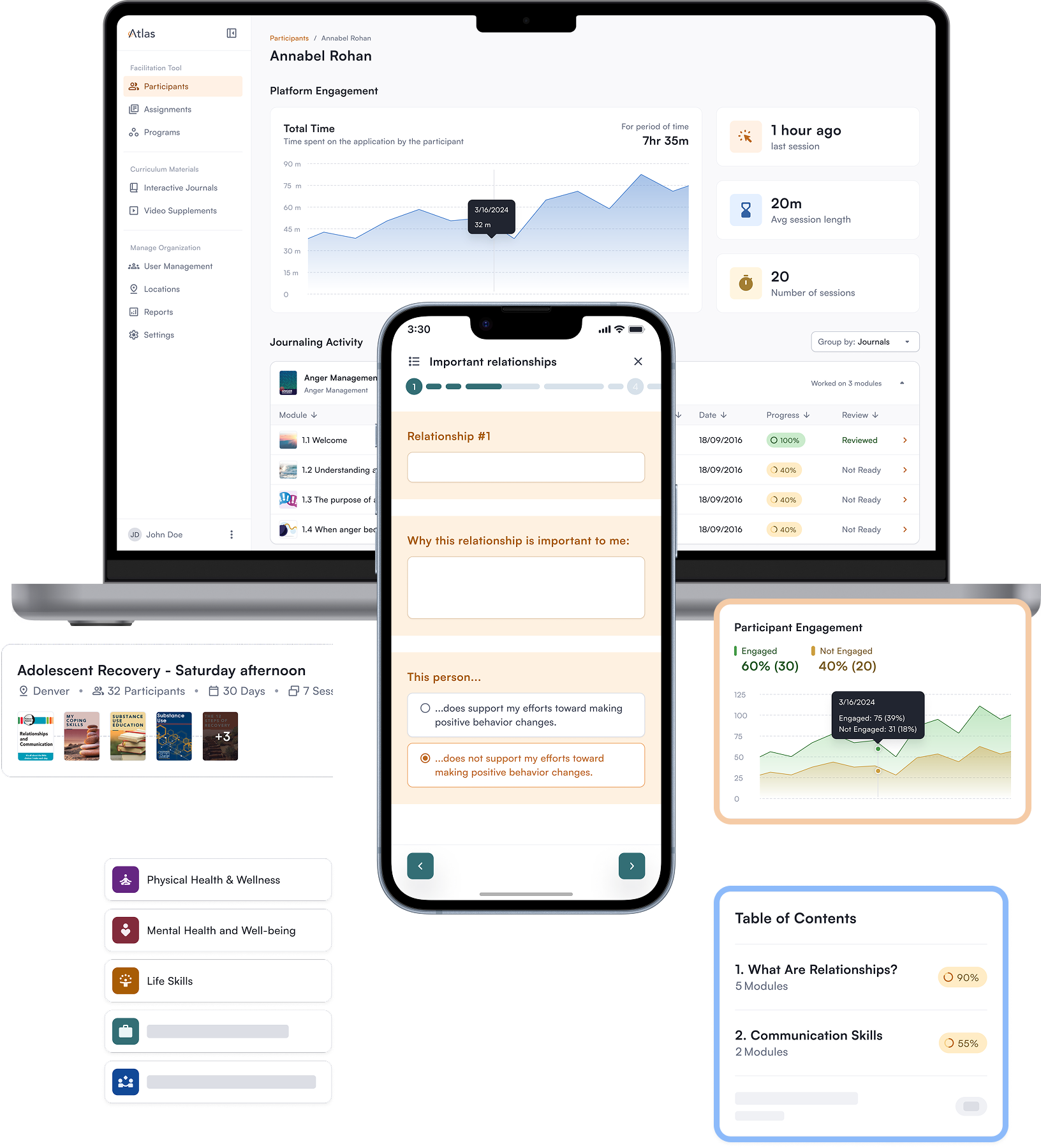
.png)